
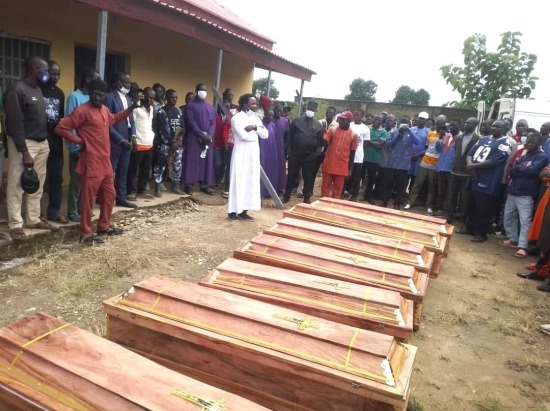


Christians in Nigeria were killed at a rate of one every 86 minutes between Jan. 1 and Sept. 8, most of them in the Middle Belt that receives low priority in Nigerian and U.S. security policy, a new report by a U.S.-based aid agency shows.
Among 4,216 Christians killed in Nigeria during the period, a majority of the documented violence against Christian farming communities appears to be religiously motivated and carried out through organized militant networks, with Fulani actors responsible for more deaths than Boko Haram and Islamic State West Africa Province (ISWAP) combined, according to the report by Equipping The Persecuted (ETP), “Crisis in the Middle Belt: Religious Persecution and Security Failure in Nigeria.” Multiple ethnic and religious communities in Nigeria suffer violence, but the religious motivation of attacks on Christian farmers is important to note to avoid flawed policy responses, the report asserts.
“When attacks are framed only as farmer-herder clashes, the actions of unknown gunmen, or generalized rural violence, mass persecution may be misinterpreted as merely a development problem or a policing failure,” ETP states. “Likewise, when the religious identity of affected communities is omitted, the religious dimension of the violence may be underrepresented in public reporting and casualty records.
As a result, targeted persecution can be absorbed into broader narratives of insecurity, obscuring both its nature and its scale.” The 4,216 deaths of Christians in Nigeria recorded by ETP between Jan. 1 and Sept. 8 represents an average of 16.8 deaths per day, or approximately one every 86 minutes. “Local disputes over land, resources, or communal identity can be deadly, but they are not equivalent to the systematic destruction or depopulation of entire villages,” the report states.
“According to Equipping The Persecuted and TruthNigeria field reporting, the destruction of villages, burning of churches, and permanent displacement