
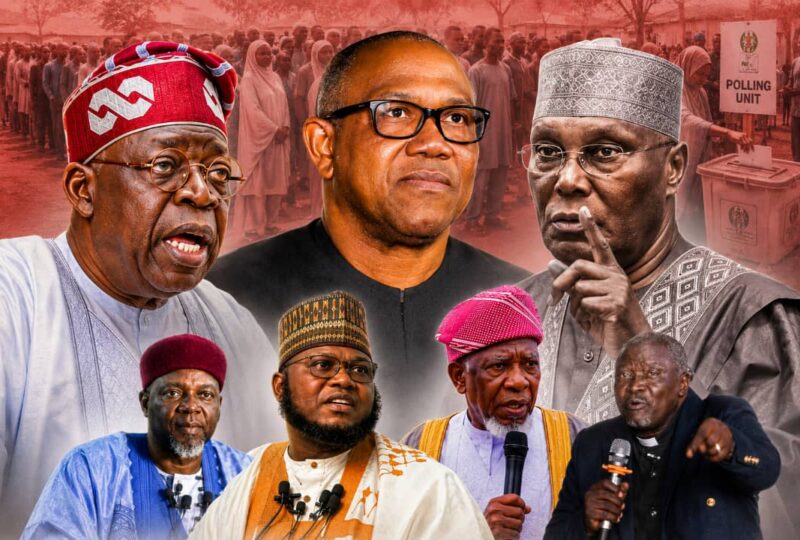


As campaign activities for the 2027 general elections get underway, clerics and politicians have quickly resorted to old rhetoric and tricks to mobilise support for their candidates. But Nigerians are challenging the attempts to use rhetoric and financial inducements to sway voters.
The presidential candidate of the opposition African Democratic Congress (ADC), Atiku Abubakar, was trying to put the personal records of President Bola Tinubu and the religious composition of his ticket on the front burner of the campaigns, before reopening the debate about fuel subsidy.
In a recent interview with JKD Media, Atiku recounted how he refused to nominate Mr Tinubu as his running mate under the Action Congress of Nigeria (ACN) in 2007 because he opposed a Muslim-Muslim ticket. He also recounted taking the same position in 2015, when former President Muhammadu Buhari was considering selecting Mr Tinubu as his running mate. In the interview anchored by Yusuf Mamman, Atiku asserted a firm position on the issue.
“I don’t believe in a Muslim-Muslim ticket because it does not bode well for the country,” he said. However, Atiku acknowledged an unsuccessful bid to become the running mate to M.K.O. Abiola in 1993, who eventually picked Babagana Kingibe, a fellow Muslim. Had Abiola selected Atiku instead, as demanded by the Shehu Yar’Adua camp to which Atiku belonged, it would also have been a same-faith ticket.
Political analysts view Atiku’s rhetoric as a deliberate political framing designed to capitalise on current religious sentiments. In Nigeria, the selection of presidential and vice-presidential candidates had been driven primarily by political calculations. For instance, in the 1979 presidential election, Nnamdi Azikiwe, the candidate of the Nigerian People’s Party (NPP), chose fellow Christian Ishaya Audu as his running mate. Mr Audu, a physician from Kaduna State, was a former Vice-Chancellor of Ahmadu Bello University,