
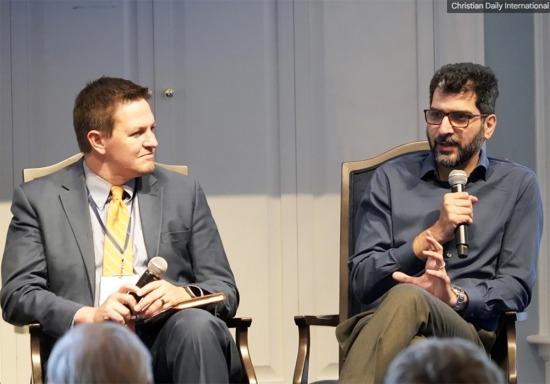


Religious freedom advocates told a gathering in Texas that armed conflict and state surveillance are undermining the methods Christians have used to defend persecuted believers. They said a divided global church is poorly placed to respond. The panelists spoke at Dallas Baptist University on Tuesday, the second day of the Global Religious Freedom Gathering. They urged churches to work across denominational lines and to take on peacebuilding as well as traditional advocacy.
Scot Bower of Christian Solidarity Worldwide moderated the session, titled "Advocacy in a Broken World: Faithful Action in Times of Conflict." Wissam al-Saliby, president of 21Wilberforce, said 65 armed conflicts are active worldwide, counting both wars between states and civil wars. Many more regions face violence from armed or separatist groups that falls short of formal armed conflict, he said. According to al-Saliby, war damages religious freedom in three ways.
Inside a country, it weakens or destroys civil society, as in Sudan. States at war also tend to restrict freedom of religion together with freedom of expression, he said, naming Russia and Iran. War also disrupts international advocacy. Al-Saliby described a campaign concerning a country he did not name.
U.S. lawmakers had already taken positions because of a conflict involving the United States, he said, so they would not take up the religious freedom case. His team turned to the Swiss parliament, which was seen as neutral, and persuaded it to send letters to that country's government. The approach worked for a time, he said, but the threat of war eventually closed that route as well.
The third problem, he said, is that the United Nations and similar bodies carry less weight than they did five years ago.