
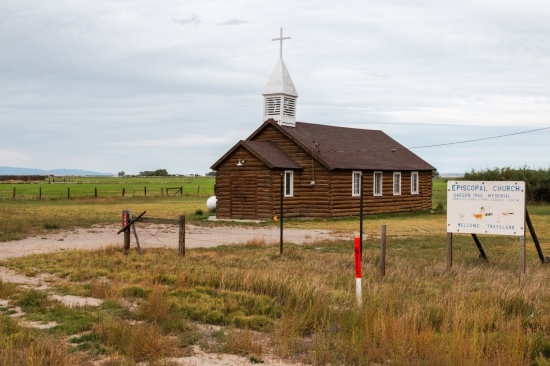


EDEN, Wyoming — Along U.S. Highway 191 stands a little log church that looks as though it has occupied this windswept landscape since the days of wagon trains. Oregon Trail Memorial Episcopal Church is not quite that old. A local carpenter built the log church between 1937 and 1938 in a revival of vernacular frontier style. It was intended as both a house of worship and a memorial to the pioneers who crossed the continent.
The church reminds me of Washington Memorial Chapel in Valley Forge, Pennsylvania. Though far smaller and humbler than that landmark, both are Episcopal churches that turn consequential chapters of American history into sacred space. The little church in Eden (population 235) also recalls the wayside chapels erected across medieval Europe. Christians traveling long distances, often on pilgrimage, could stop, pray and continue their journey. This church serves a similar purpose beside a modern highway.
The church is open year-round. Visitors can pull open the door and pass through the narthex, where they are invited to sign a guestbook. I counted about 40 entries over the previous nine months. Inside, the nave is simple but beautiful and unmistakably Episcopal. Copies of the 1979 Book of Common Prayer rest in the pews. Tucked along a side wall is a bookshelf containing dusty copies of the old 1940 Hymnal.
While the church memorializes the pioneers who traveled westward in wagons and with handcarts, it also testifies to the faith that followed them. Missionaries crossed the same overland trails, giving witness to the faith once delivered. They established missions, schools and churches. Many belonged to the mainline Protestant denominations — Episcopal, Methodist, Presbyterian and Congregationalist — that dominated American religious life in the 19th century. Does today’s Episcopal Church take pride in that pioneering past?
Or would the theological