
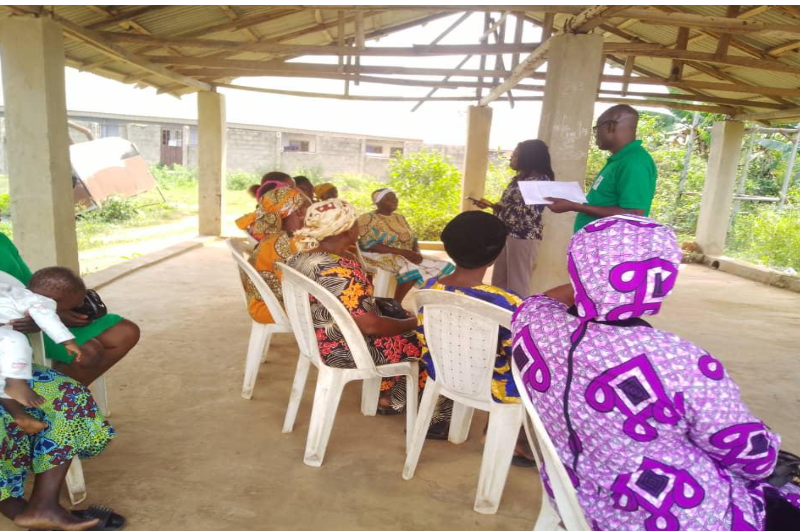


Focus Group Discussion in Idogbolu, Ogun State. Image Source: Sarah Edewor, EFInA Research Fellow, 2026 Across many rural communities in Nigeria, women farmers are increasingly confronting the harsh realities of climate change. Erratic rainfall, prolonged dry spells, flooding, and rising temperatures are making agriculture more uncertain and economically risky.
Existing literature across Sub-Saharan Africa shows that women farmers are disproportionately exposed to climate risks while also facing structural barriers to productive resources, adaptation support, and financial services. In southwestern Nigeria, farmers’ experiences of changing rainfall patterns closely align with meteorological evidence, highlighting how immediate and deeply felt climate change has become within rural farming communities.
At the same time, global evidence continues to reveal persistent gender gaps in financial inclusion, particularly in access to credit, savings, insurance, and digital financial services. These inequalities are significant because financial inclusion is increasingly recognised not only as a development objective, but also as a potential mechanism for strengthening resilience against climate-related shocks. The foundation of this study is rooted in existing literature that links financial inclusion with resilience building.
Access to savings, credit, insurance, and digital financial platforms is often associated with a household’s ability to absorb shocks, recover from losses, diversify livelihoods, and invest in adaptation strategies. However, much of the current evidence treats financial inclusion as a singular concept, focusing mainly on formal banking access and/or usage while paying less attention to how rural women actually navigate financial systems in practice.
Previous studies suggest that rural women farmers frequently rely on overlapping financial arrangements that combine formal, informal, and semi-formal systems. Despite this reality, there remains limited understanding of which combinations of financial services are most effective under climate stress, particularly for rural women farmers in Nigeria. This gap in the literature provided the basis for my study and shaped my