
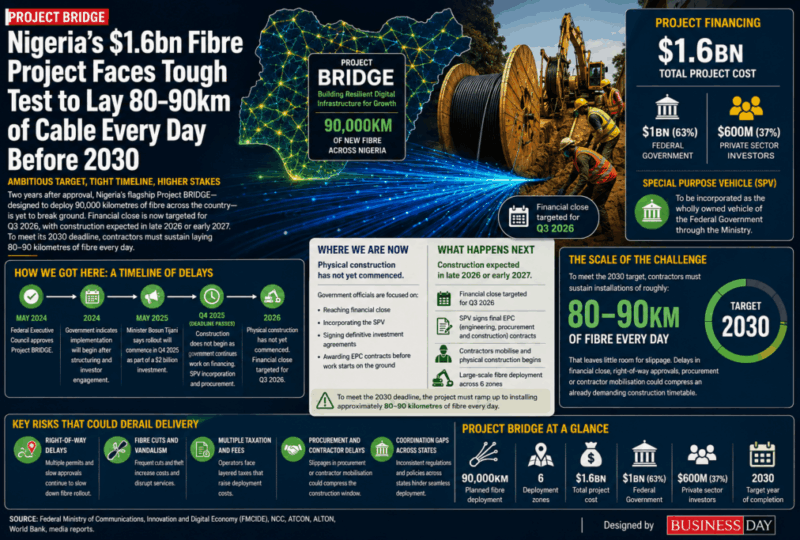


Nigeria will have to sustain one of Africa’s fastest digital infrastructure construction programmes by laying up to 90 kilometres of fibre-optic cable every day for nearly five years, if it is to deliver its flagship Project BRIDGE and meet ambitious broadband targets by 2030.
The scale of the challenge is laid bare in implementation documents for the federal government’s national fibre initiative, which calls for about 17,500 kilometres of fibre to be deployed in the first year, followed by 25,000 kilometres respectively in 2028 and 2029, before another 22,500 kilometres are completed during the first nine months of 2030. The project implementation documents show that the first phase targets the deployment of 17,500 kilometres of fibre within the first year of construction.
Assuming work is carried out throughout the year, that translates to an average of about 48 kilometres per day. The pace accelerates significantly in the following two years. The government plans to deploy 25,000 kilometres of fibre in both 2028 and 2029, requiring contractors to sustain an average construction rate of nearly 69 kilometres every day in each of those years. The most demanding phase comes in 2030.
According to the implementation schedule, the remaining 22,500 kilometres must be completed within the final nine months of the project. Spread across roughly 273 days, that requires an average deployment rate of about 82 kilometres per day. In practice, however, construction projects rarely operate continuously every day of the year. Mobilisation, adverse weather, public holidays, security challenges, right-of-way disputes and other operational interruptions could reduce the number of productive construction days.
If the effective construction window falls to around 260 days, the required pace increases to approximately 87 kilometres per day. A further reduction to about 250 productive days would push the target to roughly 90 kilometres per day. Overall,