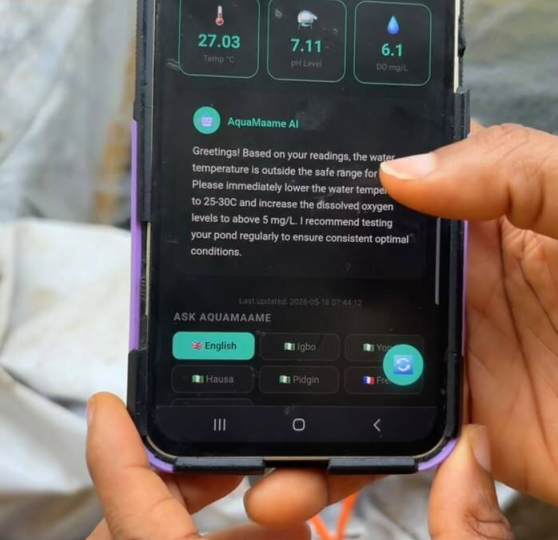


When a water quality disaster wiped out nearly a third of her mother’s fish pond, pharmacy graduate Ukachi Benita didn’t just offer sympathy. Armed with YouTube tutorials, Claude, and Google’s Gemma AI, she built Aquamanne: a low-cost hardware tool that translates real-time water sensor data into plain-language alerts in Yoruba, Igbo, and Hausa.
What started as a ₦30,000 hackathon build to solve a family crisis is now turning into a full-fledged commercial startup, backed by an Oxford lecturer and an embedded engineer, with fish farmers across Nigeria begging to buy it, writes JOHN ADOYI. By the time Ukachi Benita began asking her mother why her fish kept dying, the losses had become familiar. Fish would die in batches, sometimes leaving thousands unsold.
Her mother, who had run the farm for more than a decade, had come to see the losses as one of the risks of fish farming. Then, in March 2026, more than 3,000 fish died in a pond that held about 10,000. “It was so bad,” Benita said. “My mom was really hurt.” Benita had grown up around the farm and was used to hearing about losses, but this one troubled her.
Her mother had already spent money on feed and other costs of raising the fish, only to lose a large part of the production. When Benita asked what had happened, her mother suspected the water. The answer stayed with her. “You have already spent a lot of money on feeding and other processes and it gets to a point, they will just die,” Benita said.
“You cannot sell dead fishes.” Benita began researching fish mortality and learned that poor water quality can be one of its major causes. Yet despite knowing that water could affect the fish, her mother had no way to continuously monitor what