
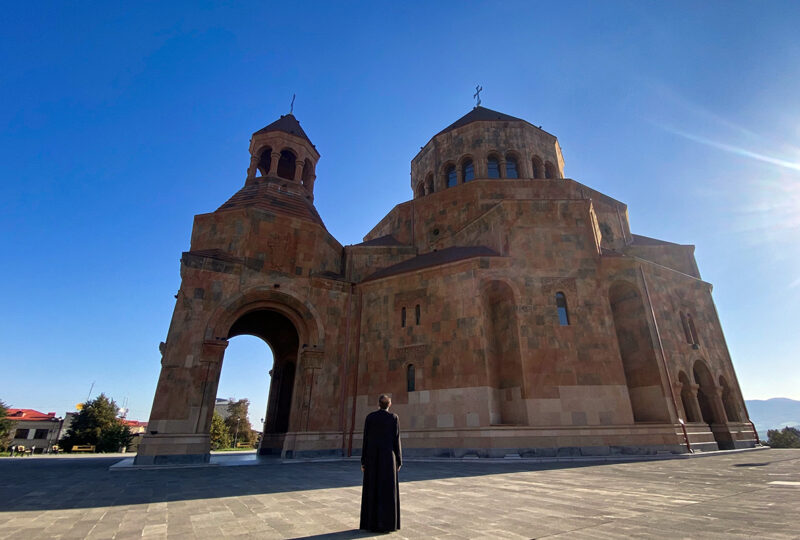


Azerbaijan now controls Nagorno-Karabakh, known to Armenians as Artsakh. The ethnic Armenian government that existed there for decades is gone. More than 120,000 Armenians were forcibly removed from their ancestral homeland following months of blockade, severe deprivation, and Azerbaijan’s September 2023 military offensive. Azerbaijan now possesses the towns where they lived, the cemeteries where they buried their dead, and the monasteries where Armenian Christians worshiped for centuries. That control carries a moral responsibility.
It does not give Azerbaijan the right to rewrite the identity of the people it displaced or the sacred places they left behind. Instead, Azerbaijan appears determined to win an argument with history itself. This month, its government brought approximately 150 representatives from 58 countries and nine international organizations on an official tour of Nagorno-Karabakh.
At the medieval monasteries of Gandzasar and Dadivank, Hikmet Hajiyev, President Ilham Aliyev’s foreign policy adviser, presented the sites as monuments of ancient Caucasian Albanian Christianity. Azerbaijani officials accused Armenians of altering the buildings and compromising their original character. Caucasian Albania was real. The fiction is the attempt to use its existence to erase the Armenian medieval identity of monuments whose walls record that history.
Gandzasar contains extensive Armenian inscriptions documenting its construction, patrons, and religious affiliation. An inscription by the thirteenth century prince Hasan Jalal identifies him as the builder and records the church’s consecration in 1240. Dadivank likewise contains Armenian inscriptions and khachkars, the distinctive carved cross stones of Armenian Christianity. By the medieval period, the Albanian Catholicosate invoked by Azerbaijani officials existed within the Armenian Apostolic Church. Gandzasar later served as its seat.
Scholars may debate the complicated history of the South Caucasus. Governments, however, have no right to remove inconvenient inscriptions from the historical record. There is certainly no justification for mocking that history, as Hajiyev is seen