
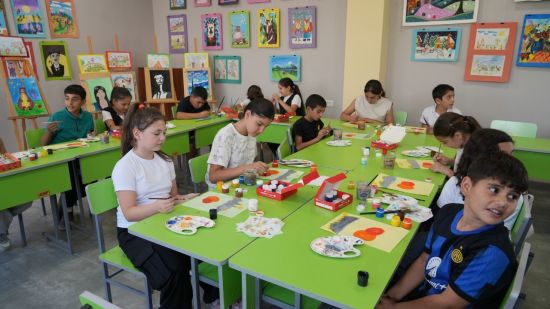


METSAMOR, Armenia — At first, the boy from Artsakh drew mostly darkness, a reflection of the trauma tied to the forced displacement of his people three years ago, but after working with a Christ-centered program, the boy has gradually begun to depict the world with more color. The boy is one of hundreds of children served by Family and Community NGO, which operates centers in Metsamor, Armavir and Artik, Armenia.
During a tour of the Metsamor center, Knarik Garanfilyan, the organization's president, presented several of the children's drawings while speaking through a translator. "He depicts war here; the clouds are black, the sun is black," Garanfilyan said about the child’s drawings. The boy arrived in Armenia following the forced displacement of the ethnic Armenian population from Nagorno-Karabakh (known as Artsakh to Armenians).
Following Azerbaijan's military offensive in September 2023, more than 100,000 ethnic Armenians fled Artsakh for Armenia. An earlier wave of displacement occurred during the Second Nagorno-Karabakh War in 2020, when approximately 90,000 people were displaced to Armenia. Control of the region has been disputed since the collapse of the Soviet Union. One of the boy's first drawings showed him beside his family's car, with their possessions packed inside as they left their home.
The drawings became part of a record of the child's progress as he worked through what he had experienced. After working with the center for about two years, the child’s drawings changed; the sun in his pictures was no longer black but yellow, and his artwork reflected that he had found a friend.
While the child’s recent artwork shows signs of healing, Garanfilyan pointed out that the drawings suggest scars that have not fully healed yet. "The problem is that the windows and doors are still black," she explained, adding that "trauma is a slow