
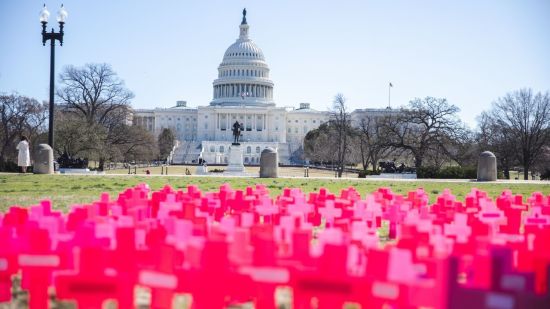


This week (Sept. 30) we commemorate the 50th anniversary of the passage of the Hyde Amendment, a congressional provision barring the use of federal funds to pay for abortion except to save the mother's life. Congress first passed the amendment on Sept. 30, 1976. After years of legal challenges, the Supreme Court upheld it in 1980 in Harris v. McRae.
Before the Hyde Amendment took full effect, an estimated 300,000 abortions were paid for each year with federal funds in the aftermath of the 1973 Roe v. Wade decision legalizing abortion on demand.
Thus, at the very least, the Hyde Amendment may have saved the lives of as many as 3.6 million babies (300,000 babies x 12 years) by 1993, when President Bill Clinton signed into law a new version of the Hyde Amendment that expanded Medicaid funding to include cases of rape and incest. Henry Hyde, the late Republican congressman from Illinois, told me personally that he considered passing the Hyde Amendment his greatest achievement as a legislator.
I agree with him. The Hyde Amendment has survived several challenges at the Supreme Court. On Jan. 24, 2017, the House voted to make the Hyde Amendment permanent (H.R. 7), though the measure did not pass the Senate. As of 2016, 57% of the American public supported Hyde, and 36% opposed it.
Opponents of the Hyde Amendment argue that it disproportionately affects low-income women, who are forced to carry babies to term because they cannot obtain federal funds to abort the child. Pro-lifers respond that it favors the unborn children of poor mothers, who are significantly more likely to be born than the children of more affluent pro-abortion mothers.
It should also be pointed out that without Hyde, pro-life taxpayers would be forced to help pay for millions of unborn citizens